Big Purchases
Your Tax Refund Isn't a Bonus. Here's the Order That Gets You Ahead.

If you’re opening this because a refund just landed and part of it is already earmarked for last year’s credit card bill, you’re not alone, and we said this was coming. When we wrote about funding the holidays ahead of time instead of financing them, we mentioned the trap waiting on the other side of the calendar: nearly a third of people who expect to carry holiday debt are planning to use the following spring’s tax refund to pay it off. If that’s you, this post is the other half of that conversation.
Even if that’s not you, the instinct to treat a refund as a single decision, save it or spend it or pay something off, undersells what it can actually do.
A note before we start. This is our perspective, built from our own household numbers and the decisions we made with them. Your situation is different, and it should be. Take this as information, apply what fits, and leave what doesn’t. The Peace of Mind Method is simply the name we gave to what we lived first and wrote down afterward. We’re not claiming results for anyone else, and nothing here is financial, tax, or legal advice.
The refund isn’t a bonus, it’s a correction
It’s worth naming what a tax refund actually is before deciding what to do with it. It’s not a gift. It’s money you already earned over the past year that you loaned to the government, interest-free, and are only now getting back. In the 2026 filing season, the average refund came in at $3,276, up 11.5% from $2,939 the year before, with the IRS returning more than $324 billion to taxpayers through early May (IRS).
That framing matters because “bonus” money tends to get spent differently than “already yours” money. A bonus feels like house money. A correction feels like what it is: income that already had a job to do and is just arriving late.
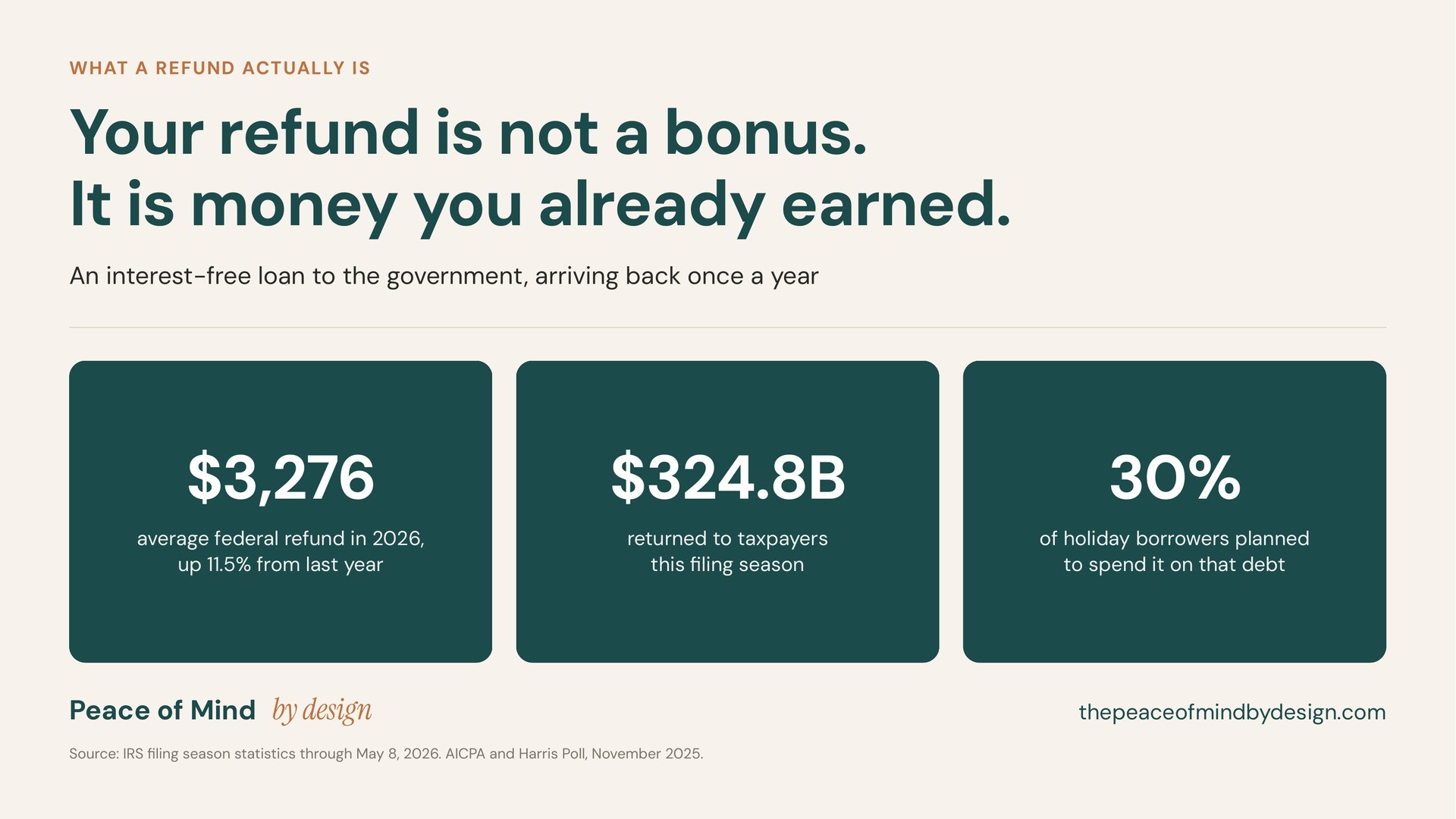
Averages for the 2026 filing season. Sources on the graphic.
What we did with ours
For six years, every refund we got had the same destination before it arrived. It went at the debt.
That wasn’t a rule we read somewhere. It came out of a decision my husband and I made early, when we sat down and actually wrote out what we owed in one place for the first time. Seeing the whole number changed how a refund felt. It stopped looking like a spring bonus and started looking like the one lump sum we got all year that could move the balance in a way our monthly payments couldn’t.
So we stopped deciding in April. Every February, before we filed, we’d already named where it was going. That mattered more than it sounds like it should. A refund that arrives without a plan spends about three weeks sitting in checking, and in those three weeks it stops feeling like debt money and starts feeling like a cushion. We never let it get to that stage. It went out the same week it came in.
Was it fun? No. There were years the refund would have covered a trip we wanted to take, and we watched it go to a balance instead. What we got back for that was time. Over six years we cleared $359,242, and we paid off our mortgage in 2024 in three and a half years. The refunds weren’t the whole story, not close, but they were six lump sums that landed on principal instead of on a vacation, and lump sums on principal do something that monthly payments do slowly.
I’ll say the honest part too. This worked for us because we had a floor underneath it. We weren’t sending refunds at debt while our emergency account sat empty, because if we had, the first car repair would have put the debt right back on a card and we’d have been running in place. That’s why the order below starts where it does, and not with the debt.
Why picking one use undersells it
Most tax season advice splits into two camps: pay off debt with it, or save it. Both are reasonable on their own, and both miss the same thing, that a single windfall doesn’t have to go to a single place. The Consumer Financial Protection Bureau’s guidance on refunds walks through identifying and prioritizing your bills and debt first, then calculating what remains, then setting a savings goal for that remainder, rather than treating it as an either-or choice (CFPB).
That’s closer to how we think about it now. A refund is a lump sum arriving once a year, and lump sums are exactly the kind of money that benefits from being split across more than one bucket, instead of getting funneled entirely into whichever goal feels most urgent in the moment.
The order that actually gets you ahead
Here’s the priority order, and the logic behind each step.
First, top off your emergency floor. If you’ve already built the number we talked about in the emergency fund piece, three to six months of your fixed costs, sitting in its own account, skip this step. If you’re below that number, this is where the first portion of the refund goes, before anything else. An emergency fund that’s short doesn’t do its job when it’s actually needed, so closing that gap takes priority over paying down debt that isn’t currently on fire.
Second, whatever’s left goes toward your highest interest rate debt. This is where a windfall is different from a regular paycheck. In the piece on snowball versus avalanche, we made the case that starting with your smallest balance can help sustain motivation over months of regular payments. A tax refund doesn’t have that problem. It arrives all at once, it doesn’t require months of continued discipline to stay in it, so there’s no behavioral reason to avoid pure interest-rate math here. Send it at whatever’s costing you the most, first.
Third, if there’s anything left after those two, that’s where it moves into your Priorities bucket, whatever you’ve named as the next real goal, a bigger investment contribution, a house project, the next thing on your list once the floor is solid and the expensive debt is smaller.
This is Step 03 of the Peace of Mind Method, Design your buckets, applied to a single lump sum instead of a monthly paycheck. The buckets don’t change because the money arrived differently. The order you fill them in does.
To put real numbers next to this, take this year’s average refund of $3,276. Say your emergency floor is $600 short of its target. That gap gets filled first. The remaining roughly $2,676 goes at your highest-rate balance, whether that’s a credit card, a store card, or a personal loan. If that balance is fully covered, only then does anything move toward the next Priorities goal. Most households will find the first two steps absorb the entire refund most years, and that’s not a failure of the plan. That’s the plan doing exactly what it’s supposed to.
Other orders that make sense
Ours is not the only defensible sequence, and I’d rather name the alternatives than pretend there’s one answer.
If you’re self-employed or your income moves month to month, a case can be made for parking the refund in cash even past the three-to-six-month mark, because an irregular income needs a deeper floor than a salaried one does.
If you have an employer match you aren’t capturing, there’s an argument for using the refund to free up monthly cash flow so you can raise your contribution to the match. A match is an immediate return that most debt interest rates don’t beat.
If your debt is all low-rate, a federal student loan on an income-driven plan or a car loan you got at a promotional rate, the math for investing the refund instead is genuinely competitive. Paying off a 3% loan when you could earn more elsewhere is a comfort decision more than a math one, and comfort is a real reason, just be honest that that’s what you’re choosing.
And if you’re getting a large refund every single year, the most valuable thing you can do with it may be to stop getting it. A big refund means you overwithheld all year, and adjusting your W-4 puts that money in your paychecks instead, where it can work for twelve months rather than sitting with the government. We didn’t do this, because we knew a lump sum was easier for us to send at a balance than a slightly bigger paycheck we’d absorb into normal life. That was a self-knowledge decision, not a math one, and you might know something different about yourself.
Set the split before the refund lands
The reason this works better as a plan than as a decision made in the moment is the same reason automation works better than willpower for a regular paycheck. Decide the split now, in percentages or dollar amounts, before you know the exact number. When it arrives, you’re executing a decision you already made clearly, not deciding under the influence of a number that suddenly feels like extra money.
It also helps to decide, in advance, how you’ll receive it. Direct deposit gets the refund into your accounts faster than a mailed check, and choosing that option when you file means less time for the money to sit somewhere general before your plan has a chance to catch it. The faster it moves from refund to already allocated, the less of it drifts toward whatever feels most tempting that week.
Why this matters even in a good year
Even if you don’t have a holiday debt or an emergency fund gap this year, the same order still applies, just with smaller stakes. A refund with nowhere urgent to go is still worth deciding on with the same clarity, rather than letting it blend into your checking account balance and quietly disappear into everyday spending over the following month. The size of the decision doesn’t change. Only the size of the refund does.
See what the split is actually worth
This is exactly the kind of decision the Freedom Financial Simulator is built to show you, free, with no signup required.
Run it twice. First, run your current numbers as they stand today, before the refund. Then run it again with the refund applied using the order above: reduce your debt balance field by whatever portion is going toward your highest-rate balance, and add the remaining portion to your investments or savings field. Keep your income, monthly surplus, and target time-freedom age the same across both runs.
Compare the two outputs. A single lump sum, split with intention instead of spent on the first thing that feels urgent, moves your time-freedom age more than most people expect from one refund. That’s the difference between a refund that quietly disappears into last year’s spending and one that actually gets you ahead of it.
Open the Simulator at thepeaceofmindbydesign.com/simulator.
About this article
Everything above reflects one household’s experience and our reading of the research cited. It’s educational, not financial, tax, or legal advice, and it isn’t a prediction of your results. The $359,242 we paid off and the mortgage we cleared in 2024 are our own household record, not a projection of what any plan will do for you. Outside figures are linked so you can check them yourself and see when they were published. Tax rules, refund averages, and withholding tables change every year, so verify anything time-sensitive before you act on it. Before making a decision that depends on your specific circumstances, talk with a licensed tax professional or financial advisor who can look at your whole picture.
Sources
Using SaaS for financial management brings a range of benefits. From real-time data insights to enhanced security and easy scalability, SaaS tools are designed to support financial accuracy and business agility. Here are a few specific benefits.
Cost Efficiency: “No large upfront costs and lower maintenance expenses.”
Accessibility: “Access your data anytime, anywhere with cloud-based systems.”
Flexibility: “Choose from scalable pricing plans that grow with your needs.
Key Benefits of SaaS for Businesses
Integrating SaaS solutions effectively requires strategic planning. Begin by identifying your business needs, selecting solutions that integrate well with your existing tools, and training your team to maximize the software’s potential. Here’s a quick checklist to help guide your implementation.
Identify Key Needs: “Define what you aim to achieve with SaaS.”
Evaluate Compatibility: “Choose tools that work well with current systems.”
Prioritize Training: “Equip your team to fully leverage new technology.
SaaS solutions offer tremendous potential for businesses seeking financial growth. By implementing the right tools and following best practices, your business can enhance efficiency, reduce costs, and prepare for sustainable growth. Start exploring SaaS options today to unlock your business’s financial potential.

Averages for the 2026 filing season. Sources on the graphic.
Share Blog
Related blogs


Take the first step toward your own financial peace.
Three doorways in. Pick the one that fits where you are.
FREE, ON-DEMAND
Financial Peace of Mind 101
45 minutes. The whole Method walked through, end to end. Watch anytime on any device.
TAKE THE COURSE
FREE TOOL
The Freedom Simulator
10 minutes. Enter your numbers. Get your Freedom Year and the payoff-versus-invest comparison delivered by email.
START WITH THE FREE SIMULATOR
GO DEEPER
The Peace of Mind Blueprint
The full operating system: six components, five financial pillars, the template library, and 12 months of access to our private community.
SEE THE BLUEPRINT
Peace of Mind by Design provides financial education and coaching. We are not licensed financial advisors and do not provide personalized investment, tax, legal, or insurance guidance.