Saving
How to Save for the Holidays Without Going Into Debt

Don’t budget the holidays. Fund them, before the season starts.
Every year, we set a number for gifts. Not a limit we’re hoping to stay under. An actual number, decided months ahead of time, already sitting in an account by the time anyone starts shopping. When December comes, we’re not budgeting anything. We’re just spending money that’s already there.
That’s a small shift in wording, budgeting versus funding, but it changes how the holidays feel for us. A budget is a rule you’re hoping to follow later. A fund is a decision you’ve already made.
The number nobody calculates
A lot of people who “budget for the holidays” are only pricing the gifts. They’re not adding in the travel, the food, the hosting, the wrapping paper and shipping and the ugly sweater for the office party. Heading into the 2025 season, 42% of holiday shoppers and travelers expected to spend over $1,000 total once gifts, travel, and food and entertaining were all counted, according to a Harris Poll survey conducted for the American Institute of CPAs (AICPA). Plenty of people never write that full number down in one place. They feel it in pieces, a gift here, a flight there, and each piece feels manageable until the credit card statement adds them up in January.
The first step isn’t a spending plan. It’s a single number: everything the season will actually cost, gifts, food, travel, hosting, all of it, added together before you spend a dollar.
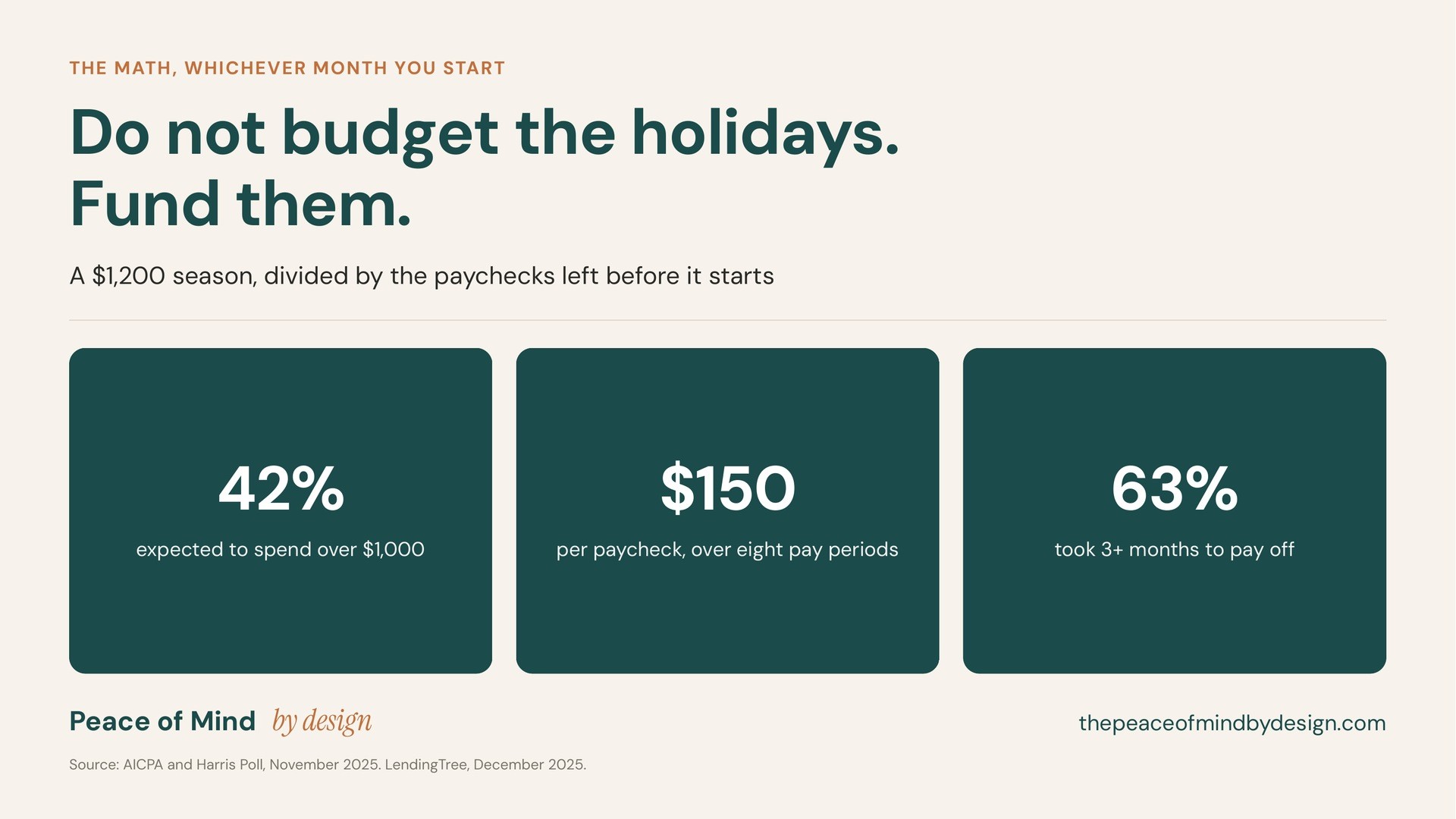
One total, divided by the paychecks left before the season starts.
Why December budgets fail
Here’s what’s honest about holiday budgets: a lot of people who make one already suspect it won’t survive contact with December. In that same AICPA survey, a quarter of holiday shoppers and travelers said they usually make a holiday budget but probably won’t stick to it, a number that climbed to 33% among adults 18 to 34, compared with 16% of those 55 and older (AICPA). Nearly half of those planning to spend on holiday gifts or travel, 47%, anticipated going into debt for it, and most of them saw it coming (AICPA). That isn’t a knowledge gap. People generally aren’t confused about how budgets work. They’re describing a system that tends to fail under pressure, and then using it again because nobody offered them a different one.
A budget asks you to make the same good decision repeatedly, in a crowded mall, in a checkout line, in the group chat where someone suggests a $200 gift exchange. Willpower is a rough tool for a repeated decision made under social pressure. That isn’t a character flaw. It’s a mismatch between the tool and the job.
The math, whichever month you start
A holiday fund removes the decision from December and moves it to now, when there’s no pressure and no line at the register. Take your total number and divide it by the paychecks you have left before the season starts.
Say your total comes to $1,200 and you have eight paychecks left before the spending begins. That’s $150 per paycheck. Automate that amount into a separate account starting with your next one, and by the time December arrives, the money is already sitting there. Nobody had to remember to be disciplined in the moment. The system did the remembering.
The exact numbers will differ for everyone. Weekly pay looks different than biweekly, your total might be higher or lower than $1,200, and the number of paychecks you have left depends entirely on when you start. What doesn’t change is the shape of the math: total cost, divided by paychecks remaining, automated from the first one. Starting earlier makes each transfer smaller. Starting later makes it larger but still finite, which is different from not having a plan at all.
Where the money sits
This works better when the money is somewhere you can’t casually spend it. In the Peace of Mind Method, this is Step 03, Design your buckets, paired with Step 04, Automate the flow. The holiday fund is its own line inside your Savings bucket, not folded into your everyday checking account where it looks like spare cash the moment you open the app.
A separate account, even a free one at the same bank, does psychological work that a mental budget can’t. Money in your checking account looks spendable. Money in a labeled holiday account looks committed. Automating the transfer means the decision to fund the holidays gets made once, at setup, instead of every single time you’re tempted to skip a transfer in October.
The conversation nobody has
The other lever, and the one people often skip because it’s uncomfortable, is telling the people you spend on what to expect before you’re standing in front of them holding a gift. We’ve kept our own gift-giving number for years, and part of what makes it work for us isn’t just the account, it’s that the people around us know roughly what to expect. Nobody’s guessing, and nobody’s trying to keep up with a number that was never said out loud.
That conversation, even a short one, is often what actually brings the total down. It’s easier to stick to $150 for a niece or nephew when the expectation was set with their parents in the fall than when you’re standing in a store in December trying not to feel cheap. Every family dynamic is different, and this conversation is genuinely harder in some households than others. Take the version of it that fits yours.
What it saves you
The stakes here aren’t abstract. Among people who took on holiday debt in the 2025 season, 63% said it would take three months or longer to pay off, and 40% were paying interest rates of 20% or higher. On top of that, 41% of that season’s holiday borrowers were still paying off debt from the year before, meaning the two seasons stacked instead of clearing (LendingTree).
There’s one more trap worth naming now, while the season is still far enough away to see it clearly. Among those who expected to carry holiday debt, 30% planned to use the following spring’s tax refund to pay it off (AICPA). That refund was never extra money. It’s a loan you take from your future self in December and repay, without interest math working in your favor, in April. A fund built ahead of time means there’s nothing waiting for that refund to clean up. If that pattern sounds familiar from a previous spring, the piece on what to actually do with your tax refund walks through an order that can get you out of it.
Start with the total, not the willpower
You don’t need more discipline to get through this December differently. You need one number, written down now, and a system that moves money toward it automatically before the season has a chance to ask you to decide in the moment.
The Starter Kit is built for exactly this kind of setup, a simple, guided way to put your buckets and automation in place before you need them.
About This Article:
Everything above reflects one household’s experience and our reading of the research cited. It’s educational, not financial, tax, or legal advice, and it isn’t a prediction of your results. Outside figures are linked so you can check them yourself and see when they were published. Survey data reflects the season it was collected in, so verify anything time-sensitive before you act on it. Before making a decision that depends on your specific circumstances, talk with a licensed professional who can look at your whole picture.
Sources:

One total, divided by the paychecks left before the season starts.
Share Blog
Related blogs


Take the first step toward your own financial peace.
Three doorways in. Pick the one that fits where you are.
FREE, ON-DEMAND
Financial Peace of Mind 101
45 minutes. The whole Method walked through, end to end. Watch anytime on any device.
TAKE THE COURSE
FREE TOOL
The Freedom Simulator
10 minutes. Enter your numbers. Get your Freedom Year and the payoff-versus-invest comparison delivered by email.
START WITH THE FREE SIMULATOR
GO DEEPER
The Peace of Mind Blueprint
The full operating system: six components, five financial pillars, the template library, and 12 months of access to our private community.
SEE THE BLUEPRINT
Peace of Mind by Design provides financial education and coaching. We are not licensed financial advisors and do not provide personalized investment, tax, legal, or insurance guidance.