Big Purchases
Paying Cash for a Car vs. Financing It: The Math Most People Never Run

A few years ago, my husband and I sat in a driveway looking at a car that needed a repair. The easy move would have been to treat it as a sign and go shop for something newer. Instead we ran a rule we’d already agreed on: we don’t spend more on a car than three times what we have sitting in savings for it. That car wasn’t worth replacing yet, so we fixed it and kept driving it. When we did eventually buy, we bought used, in cash, inside that same rule.
That rule sounds small. It isn’t. It’s the difference between a car being a decision you make once and a car being a payment that follows you around for six years.
Two things happen at once, and only one of them gets talked about
When people compare buying a car with cash to financing it, they usually focus on one number: the interest rate. Is 6% good? Is 11% bad? That’s an incomplete frame, because it only measures one side of what financing does.
Financing a car does two things to your finances at the exact same time. It adds a balance to your debt column, and it removes a chunk from your monthly surplus, the money left over after your fixed and variable costs that would otherwise go toward savings, debt payoff, or the things you actually want. A lot of people run the math on the first effect and never touch the second. That’s how a “reasonable” monthly payment can quietly reset what someone puts toward everything else for the next five or six years.
Here’s what that looks like in real numbers right now. In Experian’s State of the Automotive Finance Market report for the first quarter of 2026, the average new car payment rose to $770 a month and the average used car payment to $531 a month. The average loan term on a new vehicle stretched to 69.48 months, nearly six years, and 35.55% of new-car loans now run longer than six years, up from 30.83% a year earlier (Experian). The same Q1 2026 report puts average interest rates at 6.39% for new vehicles and 11.43% for used ones.
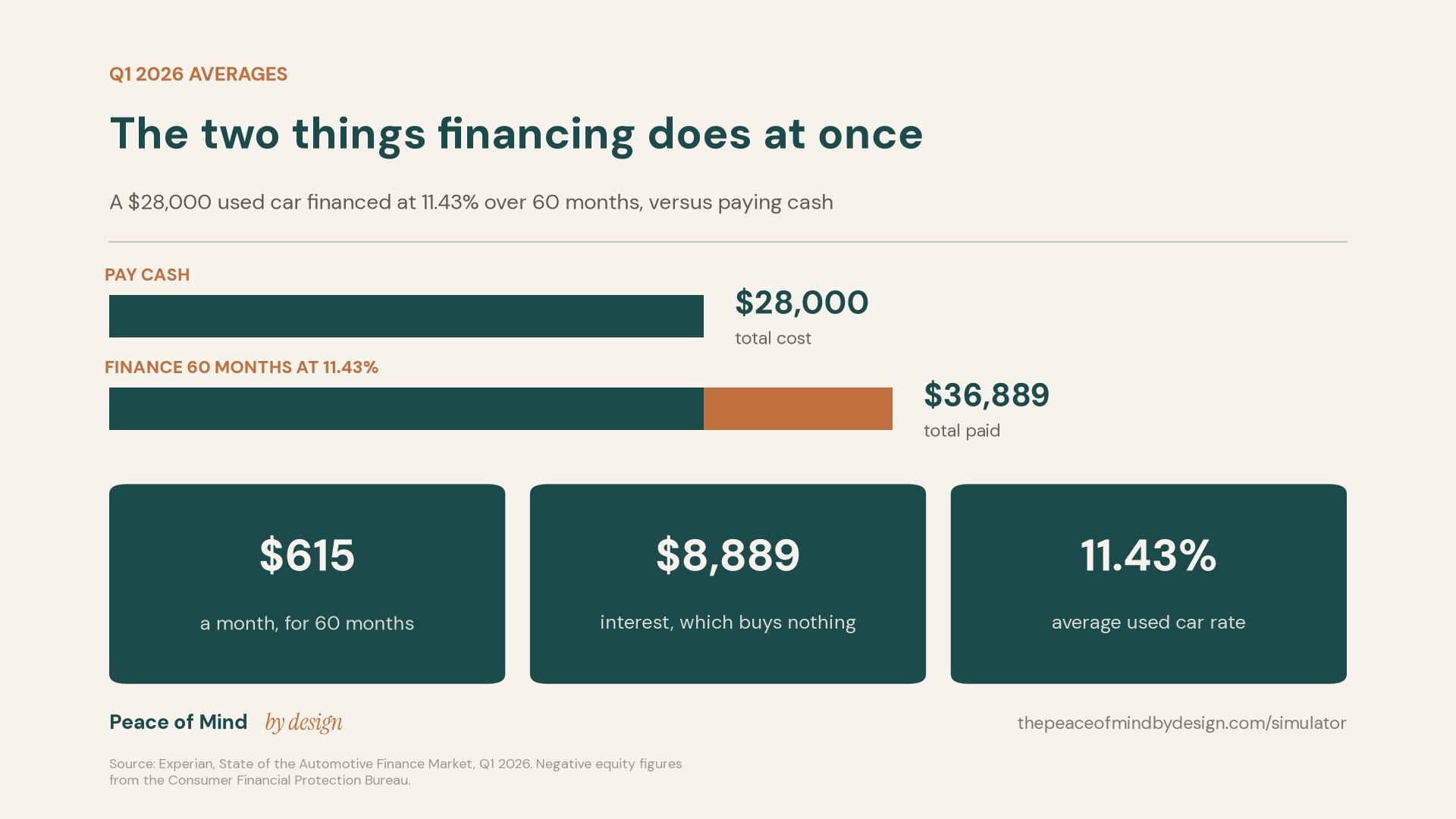
Financing a used car at the Q1 2026 average rate: what the sticker says versus what you actually hand back.
Here’s what that turns into in dollars. Finance $28,000 for a used car at the average used-car rate of 11.43% over five years, and the payment lands around $615 a month. Pay that for the full 60 months and you’ll hand back roughly $36,889 total, about $8,889 of it interest, on top of the $28,000 the car actually cost. That $8,889 didn’t buy anything. It bought the convenience of not paying $28,000 at once.
Run that forward. A $531 or $615 monthly payment isn’t just a number on a statement. It’s money that isn’t going into an emergency fund, isn’t going toward a mortgage, isn’t going into an index fund, for as long as that loan runs. The payment is the visible cost. The less visible cost is everything that money could have compounded into somewhere else.
Whether that trade is worth it depends on your situation. A reliable car you need for work is not the same purchase as an upgrade you want, and a 3% promotional rate is not the same loan as an 11% one. The point isn’t that financing is wrong. It’s that you should be able to see both effects before you decide.
Why we built a rule instead of relying on judgment in the moment
We didn’t come up with the three-times-savings rule because we’re disciplined people who don’t want nice things. We built it because we didn’t trust ourselves to make a good decision standing in a dealership with a salesperson who does this for a living and we do not.
The rule is simple: we don’t spend more on a car than three times what we have saved for that purpose. If we have $4,000 set aside for a car, we’re shopping in the $12,000 range, in cash, not financed. That number forces a ceiling before we ever look at a single listing, which means the decision gets made at home with a spreadsheet instead of in a showroom with a monthly payment calculator designed to make any number feel affordable.
It also means our default has been to fix what we already own rather than replace it. A repair bill, even an annoying one, is often cheaper than the interest on a new loan. That’s not a moral stance about frugality. It’s the math as it usually plays out, though not always. A car with a failing transmission and a rusting frame is a different calculation than one with a bad alternator, and there’s a point where repairs stop being the cheaper path.
This is a system, not willpower. We didn’t white-knuckle our way past temptation. We removed the decision from the moment it would have been hardest to make well.
Our specific multiple isn’t the important part, and three isn’t a magic number. What matters is having some ceiling you set in advance, in a calm room, rather than discovering your ceiling at the exact moment someone is asking you what monthly payment you’re comfortable with.
The part that makes financing more expensive than it looks
There’s a second layer that can make financing riskier than the sticker math suggests: what happens when the loan outlives the car’s value. The Consumer Financial Protection Bureau studied this directly. Their 2024 report on negative equity in auto lending found that when a trade-in is worth less than what’s still owed on it, that shortfall commonly gets rolled into the new loan. New-car buyers who did this carried a mean of $5,073 in rolled-over negative equity, used-car buyers carried $3,284, and borrowers who financed negative equity were more than twice as likely to have their account assigned to repossession within two years compared to borrowers who applied a positive trade-in balance (CFPB).
That’s the mechanism by which one car loan can turn into a chain of car loans, each one a little larger than the last, none of them ever fully paid off before the next one starts. Buying at a level you can pay in cash breaks that chain before it starts, because there’s no balance left to roll forward.
Naming your numbers instead of estimating them
In the Peace of Mind Method, this is Step 02, Name your numbers. Not “about $500 a month,” not “somewhere around 7%.” The actual balance, the actual rate, the actual number of months left, written down where you can see all three at once. A lot of car-buying regret doesn’t come from a bad decision made with full information. It comes from a decision made with a vague, comfortable-sounding monthly figure that never got compared to what else that money could have done.
You don’t need to be against financing on principle to want to see this clearly. You need the two effects, debt up and surplus down, sitting next to each other before you sign anything.
Run it both ways before you decide
This is what the Freedom Financial Simulator is built to show you, and it’s free with no signup required, at thepeaceofmindbydesign.com/simulator.
Run it twice. First, run your numbers as if you’re paying cash: no new loan balance, no new monthly payment leaving your surplus. Then run it a second time as if you’re financing: add the loan balance and interest rate to the other-debt fields, and subtract the monthly payment from your monthly surplus field. Keep everything else the same between the two runs, your age, target time-freedom age, and other debt.
Then look at where your time-freedom age lands in each version. That’s the fuller cost of financing, not the interest rate by itself, but what it does to the age at which your money starts working for you instead of the other way around.
You already know how to run a repair estimate or compare two listings. This is the same instinct, just pointed at the whole decision instead of half of it.
About This Article:
Everything above reflects one household’s experience and our reading of the research cited. It’s educational, not financial, tax, or legal advice, and it isn’t a prediction of your results. Outside figures are linked so you can check them yourself and see when they were published. Rates and averages change, so verify anything time-sensitive before you act on it. Before making a decision that depends on your specific circumstances, talk with a licensed professional who can look at your whole picture.
Sources:

Financing a used car at the Q1 2026 average rate: what the sticker says versus what you actually hand back.
Share Blog
Related blogs


Take the first step toward your own financial peace.
Three doorways in. Pick the one that fits where you are.
FREE, ON-DEMAND
Financial Peace of Mind 101
45 minutes. The whole Method walked through, end to end. Watch anytime on any device.
TAKE THE COURSE
FREE TOOL
The Freedom Simulator
10 minutes. Enter your numbers. Get your Freedom Year and the payoff-versus-invest comparison delivered by email.
START WITH THE FREE SIMULATOR
GO DEEPER
The Peace of Mind Blueprint
The full operating system: six components, five financial pillars, the template library, and 12 months of access to our private community.
SEE THE BLUEPRINT
Peace of Mind by Design provides financial education and coaching. We are not licensed financial advisors and do not provide personalized investment, tax, legal, or insurance guidance.