Debt Payoff
Snowball vs. Avalanche, and Which One We Actually Used

Early on, we sat down with every balance we owed written out on one page. Credit cards, a car loan, student loans, the mortgage waiting behind all of it. The obvious next question was which order to pay them off in, and the obvious next argument, if you’ve spent any time in personal finance content, is snowball versus avalanche. Smallest balance first for momentum, or highest interest rate first for math. Pick a camp.
We didn’t pick a camp. We used both, at different points, because they solve two different problems and we needed both problems solved.
What each method actually optimizes for
Avalanche orders your debts by interest rate, highest first, and throws every extra dollar at that one while paying minimums on the rest. Mathematically, this minimizes total interest paid and gets you to zero balance the fastest, dollar for dollar.
Snowball orders your debts by balance, smallest first, regardless of rate. It’s mathematically less efficient in almost every case. You will, on average, pay more total interest with snowball than avalanche.
So why does snowball work for as many people as it does? Because debt payoff isn’t purely a math problem. It’s a math problem you have to stay motivated enough to finish, and those are two different requirements.
What the research actually shows
A study published in the Journal of Marketing Research looked at data from nearly 6,000 people working through a debt settlement program and found something specific: closing out an account entirely, regardless of its dollar balance, was predictive of whether someone eliminated their debt overall. The dollar balance of closed accounts was not predictive once the researchers controlled for the fraction of accounts closed. What mattered was the act of finishing something (Gal and McShane, Journal of Marketing Research, 2012). Northwestern’s Kellogg School summarized the practical takeaway plainly: people who closed small accounts first were more likely to stay in the program and pay off everything, even though it wasn’t the fastest path on paper (Kellogg School of Management).
Worth being precise about what that study is and isn’t. It looked at people enrolled in a debt settlement program, which is a specific and fairly distressed population, and it’s an analysis of observed behavior rather than a controlled experiment. It’s also research that existed long before we wrote any of this down. It isn’t a study of the Peace of Mind Method, and it doesn’t measure anything about us or about anyone who reads this. We’re citing it because it shaped how we thought about the order, not as evidence that our approach produces a particular result.
That’s the honest tension. Avalanche wins on a spreadsheet. Snowball appears to hold up better in the messier conditions of real life, because real life includes the months where you want to quit.
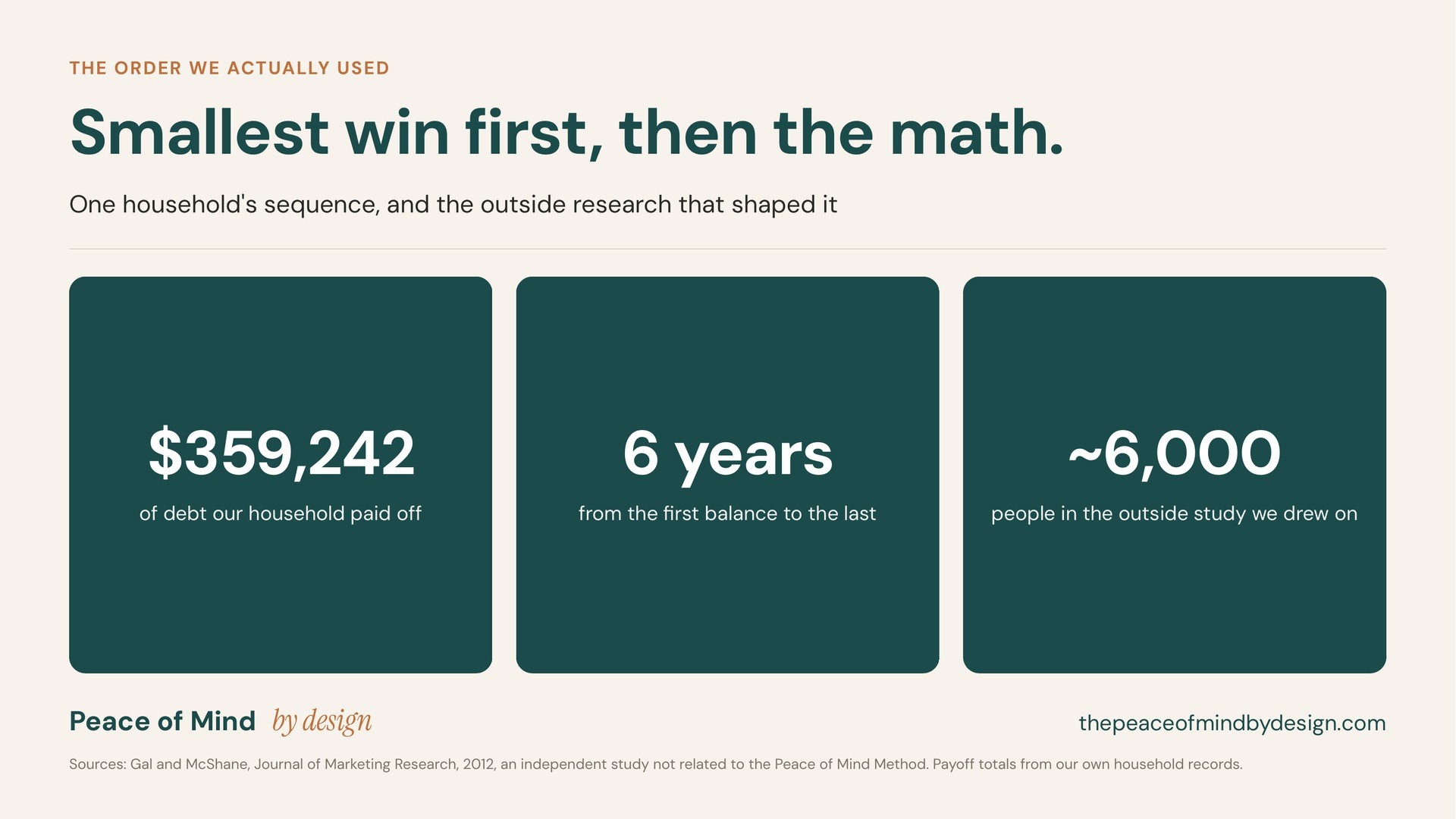
The order we used in our own household, and where the research on account closures comes from.
Why we sequenced instead of choosing
We started with the smallest balance on the list, on purpose, even though it wasn’t the highest rate. We needed a win we could see quickly, something that went from “a debt we owe” to “a debt we used to owe” within a few months, not a few years. That first closed account did something a spreadsheet can’t measure: it made the whole plan feel real instead of theoretical.
Once we had that momentum and had proven to ourselves the system worked, we shifted the remaining balances into rate order, prioritizing whatever was costing us the most in interest. By then we weren’t at risk of quitting. We were just trying to get to zero as efficiently as possible.
Over six years, running that sequence, small win first and then math-optimized, we eliminated $359,242 in total debt. That’s our household’s number, from our own records, and it came out of our specific income, timing, and circumstances. It isn’t a projection of what this order would do for you, and we don’t have data on what it has done for anyone else. What we can say is that the number wasn’t the result of picking the “correct” method. It was the result of a system we trusted enough to keep running for six years, because the beginning of it didn’t feel impossible.
We didn’t experience that first sequence as a compromise between two competing philosophies. It felt more like using the right tool for the phase we were in. Early on, the thing we were short on wasn’t information, it was proof that the plan would hold. Later, once the plan had held for a while, the thing we were optimizing for shifted to speed and cost. Different phase, different tool, same underlying goal.
What it actually costs to start with snowball
It’s worth being honest about the trade-off instead of glossing over it. If you have a $2,000 balance at 8% and a $6,000 balance at 22%, paying the small one off first while making minimum payments on the large one will cost you more in total interest than attacking the 22% balance immediately. That’s simply true, and anyone telling you otherwise is being imprecise with the math.
What the research on account closures suggests is that the extra interest can be worth paying if it’s the difference between finishing the plan and abandoning it three months in. Nobody pays extra interest on a debt they gave up on tracking. The comparison isn’t snowball versus avalanche in a vacuum. It’s snowball-then-avalanche versus a plan that quietly stops getting followed. If you’re someone who has stuck with long financial plans before without needing an early win, the avalanche math may simply be the better call for you from the start.
This is a bucket decision, not a personality test
A lot of debt content frames snowball versus avalanche as a question of what kind of person you are, a “numbers person” or an “emotional spender.” That framing doesn’t hold up well, and it isn’t especially useful. This is a design decision inside Step 03 of the Peace of Mind Method, Design your buckets, specifically inside your Debt bucket. It’s not its own step in the Method, and it doesn’t need to be treated as a bigger decision than it is. You’re choosing an order of operations, not a personality.
If the interest rate spread across your debts is small, the math barely differs between snowball and avalanche, so there’s little cost to starting with whichever gives you a faster first win. If the spread is large, say a card sitting at 20% or higher next to a balance closer to 6%, the avalanche math starts to matter more, and it’s worth weighting your order toward that high-rate balance sooner rather than later.
How to decide for yours
Write down every balance, its interest rate, and its minimum payment on one page, the same way we did. Then ask two questions. First, is there a balance small enough to close within a few months if you pointed extra money at it, and would closing it actually change how motivated you feel about the rest? Second, is there a rate high enough that leaving it for last will cost you meaningfully more in interest?
If the answer to the first question is yes and the spread in the second is small, starting small is defensible. If the spread is large, weighting toward the expensive balance sooner makes more sense, even if it’s not the smallest. Plenty of households end up doing some version of both, in sequence, the way we did. Plenty of others don’t, and do fine.
One more thing worth naming: whichever order you choose, write it down and treat it as the plan, not a rough idea you’ll adjust every time a different balance starts to feel more urgent. Constantly re-ranking your debts by mood tends to defeat the purpose of either method. The order matters less than actually following the order you picked.
Go deeper than the order
Debt sequencing is one decision inside a much bigger system. If you want to see how it fits with the rest of the Method, start with the full breakdown of all six steps on the Method page. From there, if you’re ready to design your own buckets in detail, the 90-Day Money Clarity Toolkit walks you through building yours, debt order included, over 90 days.
About This Article:
Everything above reflects one household’s experience and our reading of the research cited. It’s educational, not financial, tax, or legal advice, and it isn’t a prediction of your results. The $359,242 figure comes from our own household records and describes what happened for us, not what will happen for anyone else. The academic research cited here studies debt payoff behavior generally and is not a study of the Peace of Mind Method. Outside figures are linked so you can check them yourself. Before making a decision that depends on your specific circumstances, talk with a licensed professional who can look at your whole picture.
Sources:

The order we used in our own household, and where the research on account closures comes from.
Share Blog
Related blogs


Take the first step toward your own financial peace.
Three doorways in. Pick the one that fits where you are.
FREE, ON-DEMAND
Financial Peace of Mind 101
45 minutes. The whole Method walked through, end to end. Watch anytime on any device.
TAKE THE COURSE
FREE TOOL
The Freedom Simulator
10 minutes. Enter your numbers. Get your Freedom Year and the payoff-versus-invest comparison delivered by email.
START WITH THE FREE SIMULATOR
GO DEEPER
The Peace of Mind Blueprint
The full operating system: six components, five financial pillars, the template library, and 12 months of access to our private community.
SEE THE BLUEPRINT
Peace of Mind by Design provides financial education and coaching. We are not licensed financial advisors and do not provide personalized investment, tax, legal, or insurance guidance.