Investing
Pay Off the Mortgage or Invest the Difference

We made our final mortgage payment in 2024, three and a half years after we started throwing everything extra at it. Months later, my husband’s entire company was laid off in a single announcement. Same year. Two events that had nothing to do with each other on paper, and everything to do with each other in how they felt.
We didn’t have a mortgage payment to worry about during the job search that followed. That single fact changed the shape of that season for us. It didn’t erase the stress of a layoff, but it removed one large, recurring number from the list of things that could go wrong at the same time.
That’s the piece the math alone doesn’t capture, so let’s look at both sides honestly.
The two correct answers
If you run the numbers, paying off a mortgage early and investing the difference are both defensible choices, because they’re answering different questions.
The market-return argument goes like this: historically, the S&P 500 has returned around 10% a year on average since 1926, including dividends (Dimensional Fund Advisors), or closer to 7% a year after adjusting for inflation (Dimensional Fund Advisors). Compare that to a mortgage rate. For the week of July 30, 2026, Freddie Mac’s weekly survey put the average 30-year fixed mortgage rate at 6.66% and the 15-year at 6.04% (Freddie Mac). If your long-run investment return is likely to exceed your mortgage rate, the spreadsheet says invest the difference instead of prepaying a comparatively cheap loan.
The peace-of-mind argument doesn’t dispute that math. It points out that a paid-off mortgage is a guaranteed, risk-free return equal to your interest rate, with no volatility and no chance of a bad sequence of returns showing up the year you lose your job. Market returns are an average over decades. They are not a guarantee for any single year, including the year you might need flexibility most.
Both of these are true at the same time. Neither one is the “smart” answer and the other the “emotional” one. They’re two different bets on two different kinds of risk.
To be fair to the invest-the-difference side, the historical spread between market returns and mortgage rates is real, and over a long enough horizon it usually favors investing. If you have a mortgage locked in well below today’s rates, the math tilts even further that direction, because you’re comparing a strong expected return against a genuinely cheap loan.
The answer changes depending on what you want your money to do
Here’s what most versions of this debate leave out. “Should I pay off the mortgage or invest?” isn’t really one question. It’s four, and which one you’re actually asking determines the answer.
When you open the Freedom Financial Simulator, one of the first things it asks is what you want your money to do. There are four options, and they aren’t interchangeable:
Reach time-freedom sooner. You want to reduce the amount you need to cover each year and make work optional sooner. This goal tends to favor payoff, because lowering your annual expenses lowers the finish line itself.
Build the highest projected net worth. You want to maximize long-term growth potential. This goal tends to favor investing, because over long horizons the historical spread between market returns and mortgage rates compounds in your favor.
Eliminate monthly obligations. You want fewer required payments and greater financial certainty. This goal favors payoff almost by definition, because the thing you’re optimizing for is the absence of a bill, not the size of a balance.
Balance debt payoff and investing. You want to make progress on both at the same time. This is the split-the-difference path, and it’s a legitimate answer rather than a failure to commit.
Two households with identical mortgage balances, identical rates, and identical surpluses can run the same math and correctly arrive at opposite conclusions, because they picked different goals. That isn’t one of them being wrong. That’s the question having more than one right answer.
The simulator calculates and shows every path regardless of which goal you pick, so you can see what you’re gaining and what you’re giving up rather than just being told what to do.
Which one we chose, and what we’d tell our younger selves
We picked time first. Not the highest projected net worth, and not the biggest portfolio at 65. We wanted the years back sooner, and we wanted fewer required payments hanging over us while we got them. So we chose to pay off our debt aggressively, because that was the fastest route to peace of mind for us, and peace of mind sooner was worth more to us than the theoretical maximum on a spreadsheet decades out.
We’d make that call again. It’s the reason a layoff landed the way it did instead of the way it could have.
But we want to be straight about the other half of it. We know investing is valuable. We’re doing much more of it now than we were then, and the compounding math on the years we didn’t invest is real and it doesn’t come back. If we could tell our younger selves one thing, it would be to invest more, earlier, alongside the payoff rather than almost entirely after it. Time in the market is the one input you can never buy back later, and we spent some of it optimizing for a different thing.
That’s not a regret about paying off the house. It’s a lesson learned about the balance, and it’s part of why the fourth option exists in the simulator at all. You don’t have to pick a side as completely as we did.
What the math alone misses
Here’s the part that rarely gets said out loud: paying off your mortgage doesn’t just eliminate a monthly payment. It lowers your required retirement expense target, which is the number that determines how much you need saved before you can stop working.
That matters because it pulls your time-freedom age in from two directions at once. Investing the difference grows the asset side of the equation. Paying off the mortgage shrinks the expense side you’re saving toward. Most comparisons only look at the first effect. The second one is just as real, and it’s the one that made our own math work in favor of paying it off years ahead of the standard 30-year schedule.
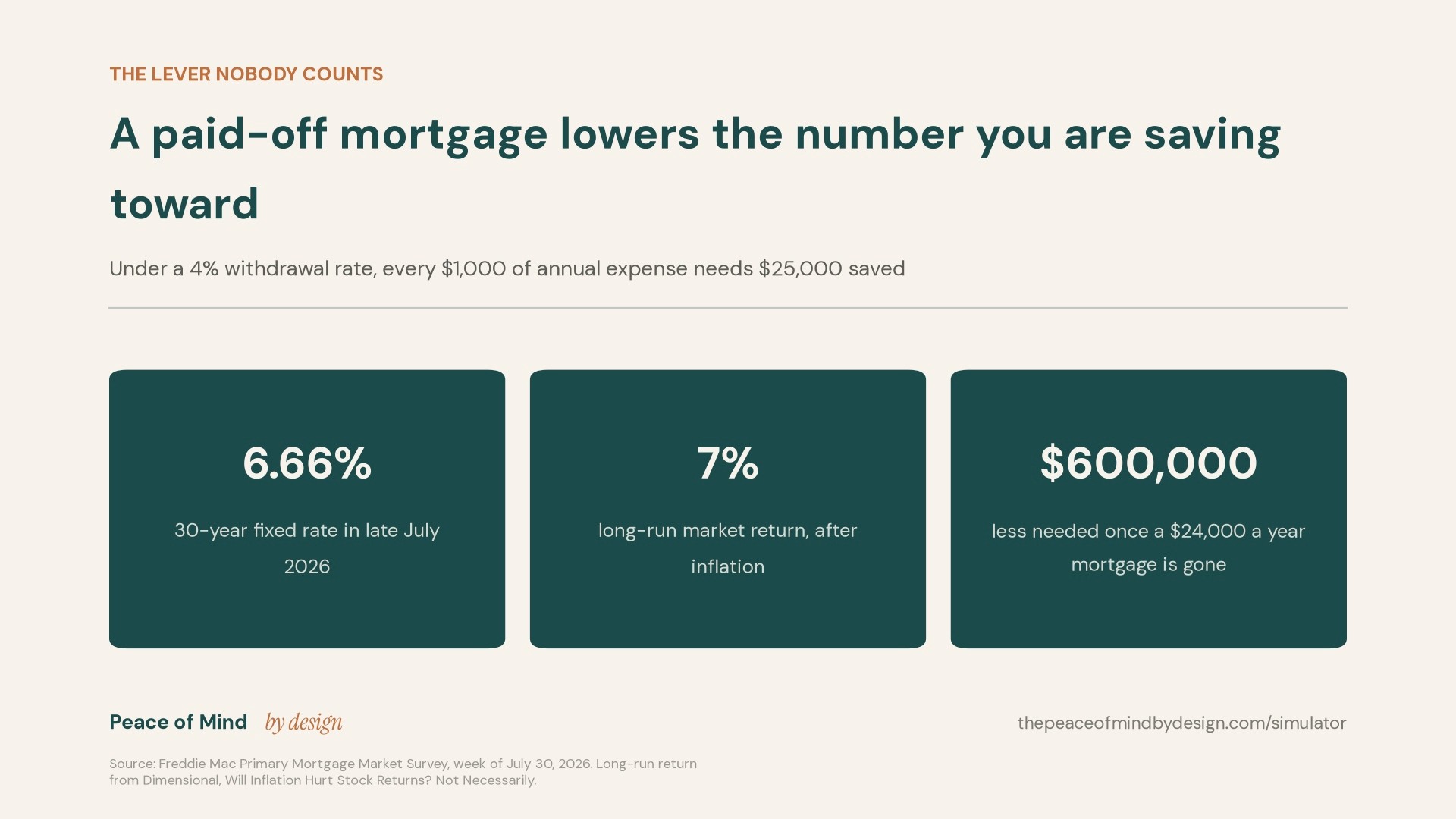
The lever most mortgage-versus-invest comparisons leave out entirely.
Think about what retirement withdrawal math actually requires. If you’re planning around a 4% withdrawal rate, every $1,000 you shave off your annual expenses lowers the total nest egg you need by roughly $25,000. A paid-off mortgage that removes, say, $24,000 a year in principal and interest payments can lower your required savings target by $600,000 under that same math. That isn’t a rounding error. It’s a second lever most comparisons leave out, because they’re only measuring what happens to your assets, not what happens to the number your assets are being measured against.
Worth noting the limits of that framing too. Property taxes, insurance, and maintenance don’t disappear when the mortgage does, so the expense reduction is the principal and interest portion, not your entire housing cost. And the 4% withdrawal rate is a planning convention, not a law of nature.
Naming your numbers before you decide
In the Peace of Mind Method, this is Step 02, Name your numbers. Not a general sense that “the market usually does well” or “our rate feels kind of low.” The actual numbers: your mortgage balance, your actual interest rate, your realistic assumption for investment returns, your current age, the age you’re targeting for time freedom, and what your expenses look like both with and without a mortgage payment in the picture.
Households in different situations should land in different places here, and the goal you picked above is a big part of why. A lower mortgage rate locked in years ago strengthens the case for investing. A rate closer to today’s average, a household that values predictability over the next optimal dollar, or a single income supporting the family all strengthen the case for paying it down. There’s no universal right answer, but there is an answer that fits your numbers and your goal.
This is also not an all-or-nothing decision. Plenty of households deliberately split, directing a portion of their surplus toward extra mortgage principal and the rest toward investments. Naming your numbers works the same way regardless of which path, or which blend of paths, you choose. The point isn’t to arrive at a single “correct” allocation. It’s to make the choice with your actual numbers in front of you instead of a rule of thumb borrowed from someone else’s household.
Run it both ways before you decide
This exact comparison is what the Freedom Financial Simulator is built to show you, free, with no signup required, at thepeaceofmindbydesign.com/simulator.
Start by picking the goal that actually matches what you want, then run the comparison twice. First, run it as the mortgage-payoff path: increase the monthly surplus going toward the mortgage until it’s paid off on your target timeline, then lower your annual retirement expense field to reflect what your household would spend without a mortgage payment. Second, run it as the invest-the-difference path: keep the mortgage on its normal schedule, and add that same monthly amount to your investments field, using a realistic long-run return assumption. Keep your age, other debt, and target time-freedom age the same across both runs.
Then compare where your time-freedom age and projected net worth land in each version. If you’re torn, try it once with a different goal selected and watch how the recommendation shifts. That’s the clearest way to see that the disagreement in this debate is usually about goals, not about math.
We can tell you what worked for us and why, and what we’d do differently. We can’t tell you what’s right for your household. The simulator can show you every path at once, so you’re deciding with your actual numbers instead of someone else’s story.
About This Article:
Everything above reflects one household’s experience and our reading of the research cited. It’s educational, not financial, tax, or legal advice, and it isn’t a prediction of your results. Historical market returns describe the past and don’t guarantee future performance. Mortgage rates change weekly, so verify current figures before you act on them. Outside figures are linked so you can check them yourself. Before making a decision that depends on your specific circumstances, talk with a licensed professional who can look at your whole picture.
Sources:

The lever most mortgage-versus-invest comparisons leave out entirely.
Share Blog
Related blogs


Take the first step toward your own financial peace.
Three doorways in. Pick the one that fits where you are.
FREE, ON-DEMAND
Financial Peace of Mind 101
45 minutes. The whole Method walked through, end to end. Watch anytime on any device.
TAKE THE COURSE
FREE TOOL
The Freedom Simulator
10 minutes. Enter your numbers. Get your Freedom Year and the payoff-versus-invest comparison delivered by email.
START WITH THE FREE SIMULATOR
GO DEEPER
The Peace of Mind Blueprint
The full operating system: six components, five financial pillars, the template library, and 12 months of access to our private community.
SEE THE BLUEPRINT
Peace of Mind by Design provides financial education and coaching. We are not licensed financial advisors and do not provide personalized investment, tax, legal, or insurance guidance.