Budgeting Systems
Budgeting When Willpower Keeps Failing

I’ve deleted a budgeting app off my phone more than once. Not because I didn’t understand it. I could have explained the 50/30/20 rule to you in my sleep. I deleted it because knowing the rule and living inside it every single day, at every purchase, in every unplanned moment, are two completely different jobs, and the second one is much harder than the first.
If that sounds familiar, it may not be a discipline problem. It may be a design flaw in the tool.
That distinction matters more than it sounds like it should. People who quit budgeting apps often internalize it as a personal failing, one more piece of evidence that they’re bad with money. That story isn’t especially accurate, and it isn’t useful. It just makes the next attempt harder to start, because you’re carrying the weight of every previous attempt into it.
You already know the rules
A lot of people who “fail” at budgeting aren’t failing from a lack of information. Debt.com’s 2026 budgeting survey found that roughly 85% of respondents keep some form of budget, and most of them say it helps (Debt.com). The knowledge is widespread. What’s inconsistent is whether the plan survives contact with an actual Tuesday, an actual grocery run, an actual moment of stress where the easiest thing in the world is to not think about the spreadsheet.
A traditional budget asks you to make the same good decision, over and over, at the exact moments you’re least equipped to make it well: tired, distracted, standing in a checkout line. That’s a structural mismatch between how the tool works and how people tend to behave under repeated pressure, not something you can think your way out of by trying harder.
There’s a name for part of what’s happening. Behavioral economists call it present bias, the well-documented tendency to weight an immediate cost or reward much more heavily than a future one, even when we know, rationally, that the future consequence matters more. A budget relies on you overriding that bias in the moment, every time, with nothing but memory and resolve. That’s asking a lot of anyone, repeatedly, for months at a stretch.
This won’t describe everyone. Some people genuinely do well with a hands-on budget they review weekly, and if that’s you, there’s no reason to abandon something that’s working. This is for the people it hasn’t worked for.
Why more willpower isn’t the fix
Behavioral economists have studied this exact gap, and one of the most useful findings isn’t about budgeting specifically, it’s about saving. Richard Thaler and Shlomo Benartzi designed a program called Save More Tomorrow, where instead of asking people to cut their spending right now, they asked people to commit in advance to saving more starting with their next raise, automatically, unless they opted out. At the first employer to try it, 78% of those offered the plan joined, 80% of participants remained enrolled through the fourth pay raise, and average savings rates rose from 3.5% to 13.6% over the course of 40 months (Thaler and Benartzi, Journal of Political Economy, 2004).
To be clear about what that is: it’s research on an employer retirement savings program from the early 2000s, not a study of budgeting systems and not a study of anything we built. We’re citing it because the underlying mechanism, one decision made in advance instead of many decisions made under pressure, is the same mechanism we ended up relying on in our own household.
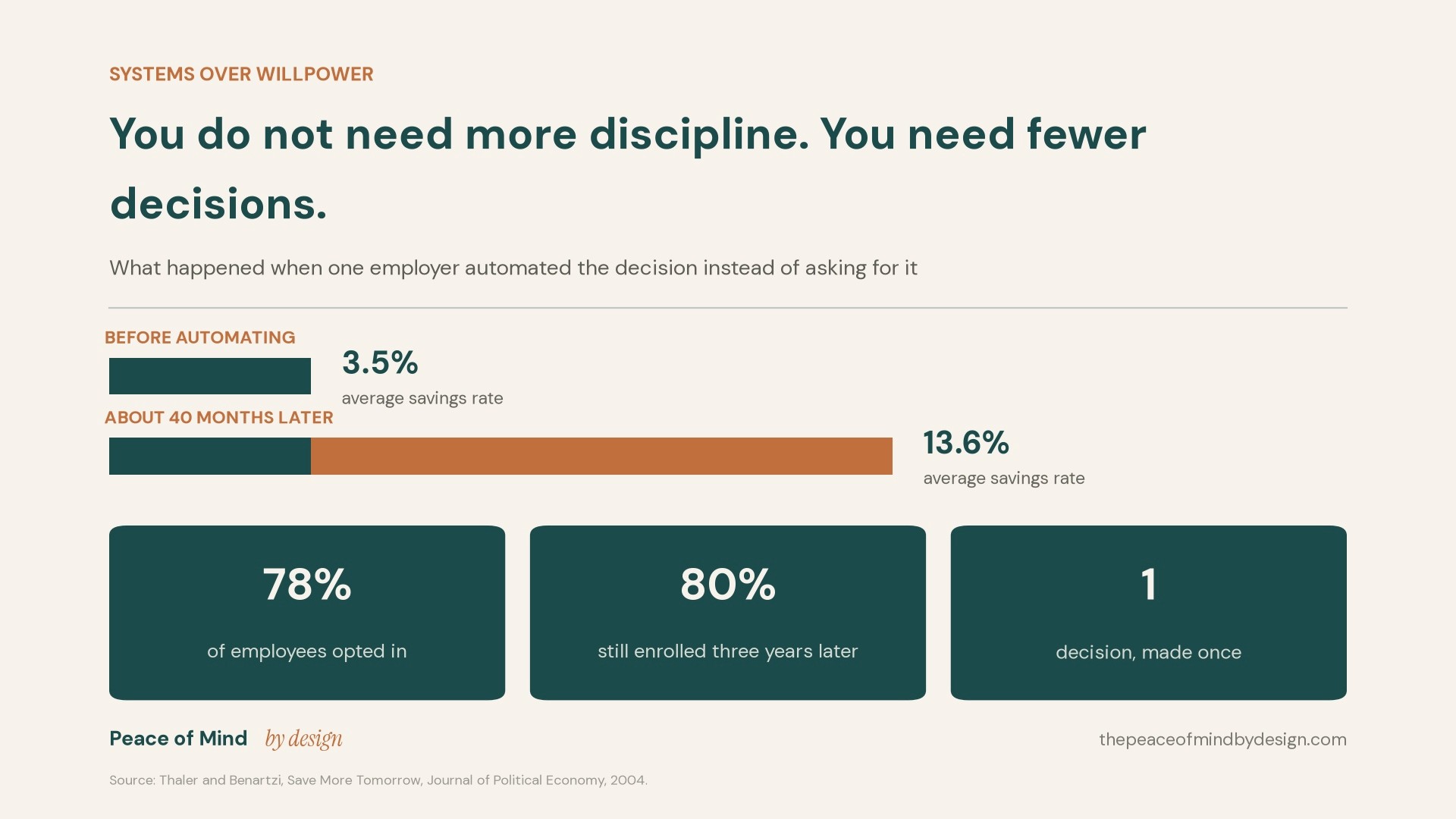
What happened when one employer automated the decision instead of asking for it.
Nothing about that program required more discipline. It required one decision, made one time, that then ran on its own. That’s the thesis behind systems over willpower: you don’t need to win the same fight every day if you only have to fight it once, at setup, and then let structure carry the rest.
What automation actually replaces
This is Step 04 of the Peace of Mind Method, Automate the flow. Once your buckets are designed in Step 03, Fixed, Variable, Debt, Savings, and Priorities, the movement of money between them doesn’t have to require a decision every payday. Scheduled transfers, set up once, do a similar job to what Save More Tomorrow did for retirement savings: they take a good decision you made when you were thinking clearly and protect it from every future moment when you might not be.
A budget you have to manually follow asks for willpower every day. A system you’ve automated asks for it mostly once, when you set it up. After that, the money is already where it needs to be before you’re tempted to spend it somewhere else.
What this looks like on an actual paycheck
Say your paycheck lands on the 1st and 15th. Instead of watching the full amount sit in checking and trying to remember not to spend the part that’s already spoken for, you set transfers to fire the same day the deposit clears. A set amount moves to cover the Fixed bucket’s share of rent and bills. Another moves to Savings and Debt. What’s left in checking after those transfers is the number you actually have to spend for that pay period, not a number you have to calculate in your head every time you consider a purchase.
Nothing about that requires you to be more careful in the moment. The moment already happened, automatically, on payday, when you were thinking clearly and nothing was tempting you.
One honest caveat: automation assumes reasonably predictable income and a cushion in checking. If your income is irregular, or if the timing of a transfer could overdraft you, build the buffer first and automate smaller amounts until the timing is safe. A system that triggers overdraft fees isn’t a system, it’s a new problem.
Start small, protect it with structure
You don’t need every bucket automated on day one. Start with your Fixed bucket, the bills that don’t change month to month, and automate those first so the non-negotiables are never in question. Add your Savings and Debt bucket transfers next, timed to land right after payday, before that money has a chance to feel like spare cash sitting in checking.
Whatever’s left after those transfers is genuinely yours to spend without guilt or a second-guessing spreadsheet. That’s not a loophole in the system. That’s the system working. The goal was never to control every dollar. It was to protect the dollars that matter most, automatically, so the rest of your money is actually free to enjoy.
This isn’t about restricting spending or moralizing about what you buy with what’s left. A system that only ever tells you no isn’t sustainable either, and it isn’t the point. The point is narrowing the number of decisions that actually require your attention. Once Fixed, Savings, and Debt are handled automatically, the main decision left most days is how to enjoy the money that’s already been set aside to be enjoyed.
When automation needs a second look
Automating the flow doesn’t mean setting it up once and never touching it again. Revisit the amounts when your income changes, when a debt gets paid off and frees up room for a bigger savings transfer, or when a bucket has been consistently running short and the automated number needs to catch up to reality. The difference between this and a traditional budget is that these are occasional, deliberate adjustments to a system that’s otherwise running itself, not a daily negotiation with your own impulses.
Set it up once
If you’ve tried budgeting apps, spreadsheets, and sheer resolve and still end up back where you started, a stricter version of the same approach may not be the fix. A different mechanism might be, one that works whether or not you’re feeling disciplined that day.
The Starter Kit walks you through designing your buckets and automating the flow between them, step by step, so the system is doing the work instead of you having to remember to.
About This Article:
Everything above reflects one household’s experience and our reading of the research cited. It’s educational, not financial, tax, or legal advice, and it isn’t a prediction of your results. The academic research cited here studies savings and budgeting behavior generally and is not a study of the Peace of Mind Method. Outside figures are linked so you can check them yourself and see when they were published. Before making a decision that depends on your specific circumstances, talk with a licensed professional who can look at your whole picture.
Sources:

What happened when one employer automated the decision instead of asking for it.
Share Blog
Related blogs


Take the first step toward your own financial peace.
Three doorways in. Pick the one that fits where you are.
FREE, ON-DEMAND
Financial Peace of Mind 101
45 minutes. The whole Method walked through, end to end. Watch anytime on any device.
TAKE THE COURSE
FREE TOOL
The Freedom Simulator
10 minutes. Enter your numbers. Get your Freedom Year and the payoff-versus-invest comparison delivered by email.
START WITH THE FREE SIMULATOR
GO DEEPER
The Peace of Mind Blueprint
The full operating system: six components, five financial pillars, the template library, and 12 months of access to our private community.
SEE THE BLUEPRINT
Peace of Mind by Design provides financial education and coaching. We are not licensed financial advisors and do not provide personalized investment, tax, legal, or insurance guidance.